SciLM Atomic Structure
Give it what you measured. Get the atomic structure back.
Any experiment, a prompt for what you expect, as much or as little data as you have. It returns the atomic structure that fits all of it, ranked candidates and the experiment that would tell them apart. Structure determination is the biggest problem in materials characterization; this is the model that solves it.
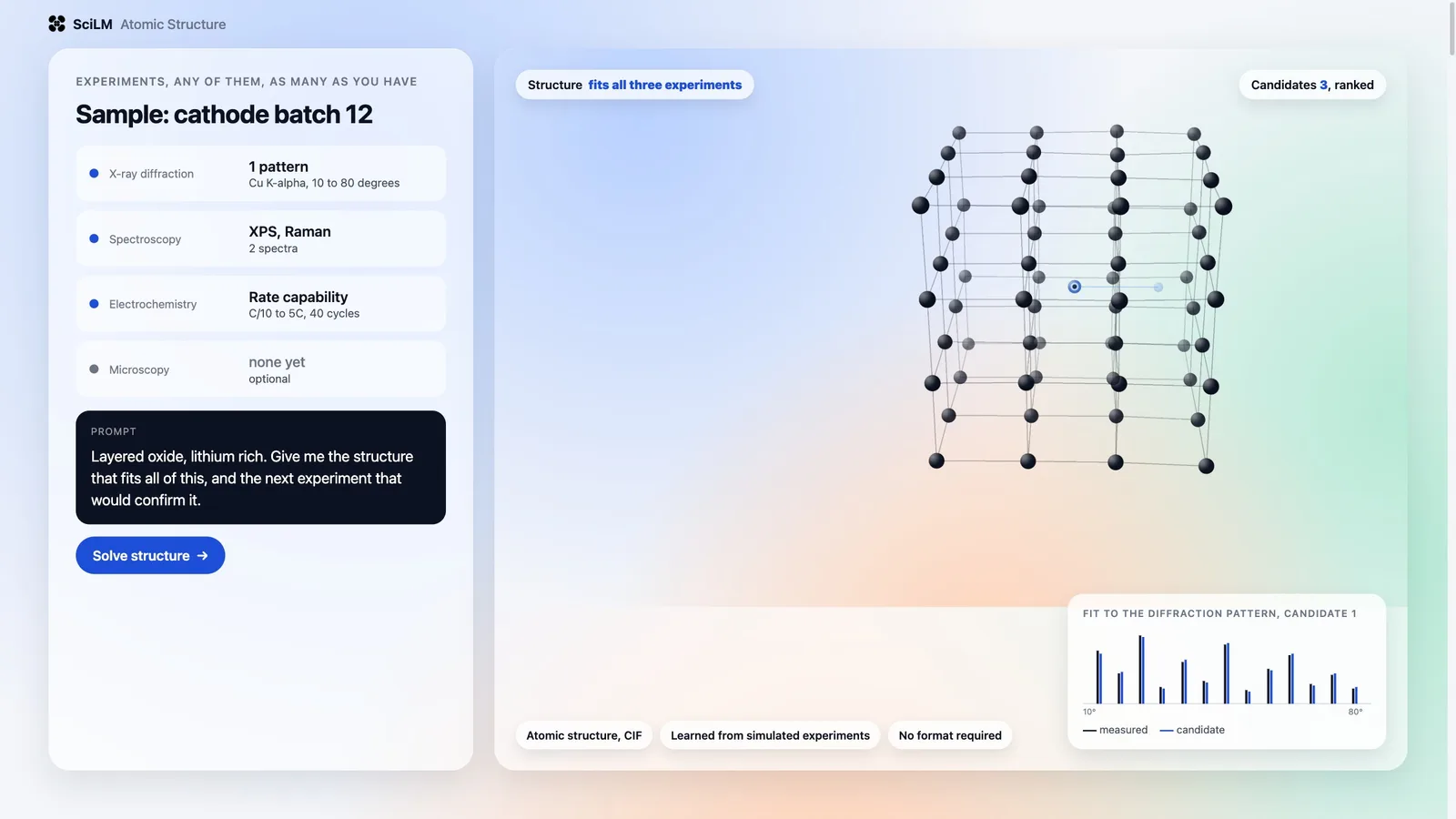
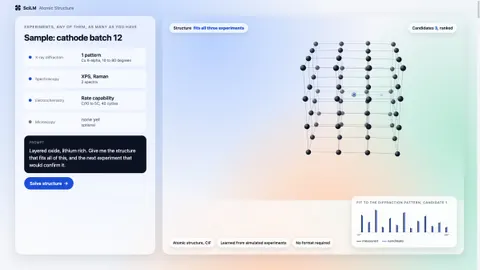
The interface as designed; the model behind it is described below.
What you give it
- Diffraction: an X-ray or neutron pattern, as measured.
- Spectroscopy: XPS, Raman, infrared, whichever you ran.
- Electrochemistry and microscopy: cycling data, rate capability, images.
- A prompt: what you expect, in plain words. No format is required and nothing is mandatory.
What you get
- The atomic structure that fits every experiment at once, as a CIF.
- Ranked candidates, each with its fit to every measurement you gave, so you see why the first one wins.
- The next experiment that would tell the candidates apart.
- Days of iteration saved: one pass over all the data instead of a new experiment per guess.
How it works.
We generate the dataset no laboratory could. Pairs: an atomic structure, and every experiment simulated on it, diffraction, spectroscopy, microscopy, electrochemistry. Simulating the experiment from the structure is the easy direction, and computers have done it for decades. Doing it millions of times gives a dataset in which every measurement comes with the answer.
A generative model learns the inverse. Trained on those pairs, it runs the hard direction: from the experiments back to the structure. Today a scientist iterates on experiments to understand a structure, and an LLM would iterate the same way through tools, one at a time, reading each result back as text. No single model can take all experiments in and put an atomic structure out. SciLM Atomic Structure is that model: the true multimodal model, reading spectra, patterns, images and words together.
It reasons about the material, not about a file. A text model cannot produce an atomic structure. A model trained on the structures themselves can, and it starts from a good first guess the way an experienced chemist does.
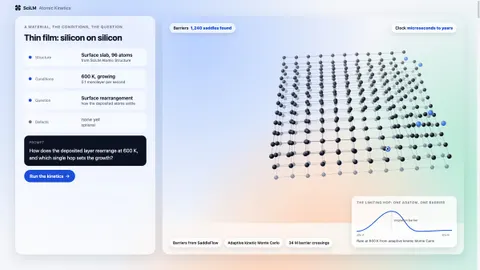
Pair it with SciLM Atomic Kinetics to learn how the material moves: ion transport in a battery or a solid-state electrolyte, reaction rates on a catalyst, how a semiconductor surface rearranges, which single hop limits the rate.