Data
More than every laboratory in history has measured.
Generated by physics-based simulation, with the domain expertise of geoscientists, physicists, chemists and engineers built in. The first datasets are open, under CC-BY 4.0, with the engines that made them. The next will be licensed, or generated to your specification.
Released so far.
MaterialsSaddles
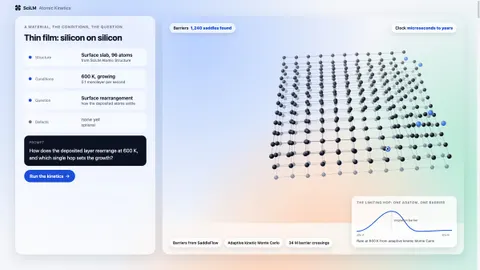
Reactant, transition state and product for reactions across inorganic materials.
34.14 Mreactions
102.4 Mstructures
687 GBCC-BY 4.0
SiliciclasticReservoirs
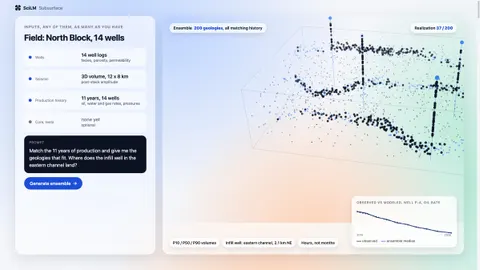
Synthetic 3D oil and gas reservoirs across eight depositional architectures, with facies, porosity and permeability per voxel.
1,000,000reservoirs
8architectures
787 GBCC-BY 4.0
Data to order.
The engines that generated a million reservoirs and 34 million barrier crossings run for you: your system, your scale, your sampling, in the form your models read. Exclusive or non-exclusive licenses, for the subsurface and for materials alike.
The engines
- SaddleMill (MIT): high-throughput transition-state generation across inorganic materials.
- ResMill (MIT): rule-based 3D reservoir modeling, eight depositional architectures.
- PotMill (BSD-3): an ML interatomic potential from data generation to the final model in under one day.
The models
- SaddleFlow: the first generative model for transition states in inorganic materials; behind SciLM Atomic Kinetics.
- ResFlow: one model for every siliciclastic reservoir type, any wells, any field size; behind SciLM Subsurface.
- Both papers are under review at NeurIPS 2026.