SciLM Atoms
Ask it why your catalyst breaks down. Get the answer, and what to change.
Upload everything you have on your catalyst: activity over time, the conditions it ran under, characterization before and after, the procedure you followed. Then ask the question you would ask an expert: why does it lose activity in a week, what would make it last a month, which step to change. SciLM Atoms answers by running atomic-scale simulations of your catalyst, grounded in physics and sped up with AI, on its own, with no one in the loop.
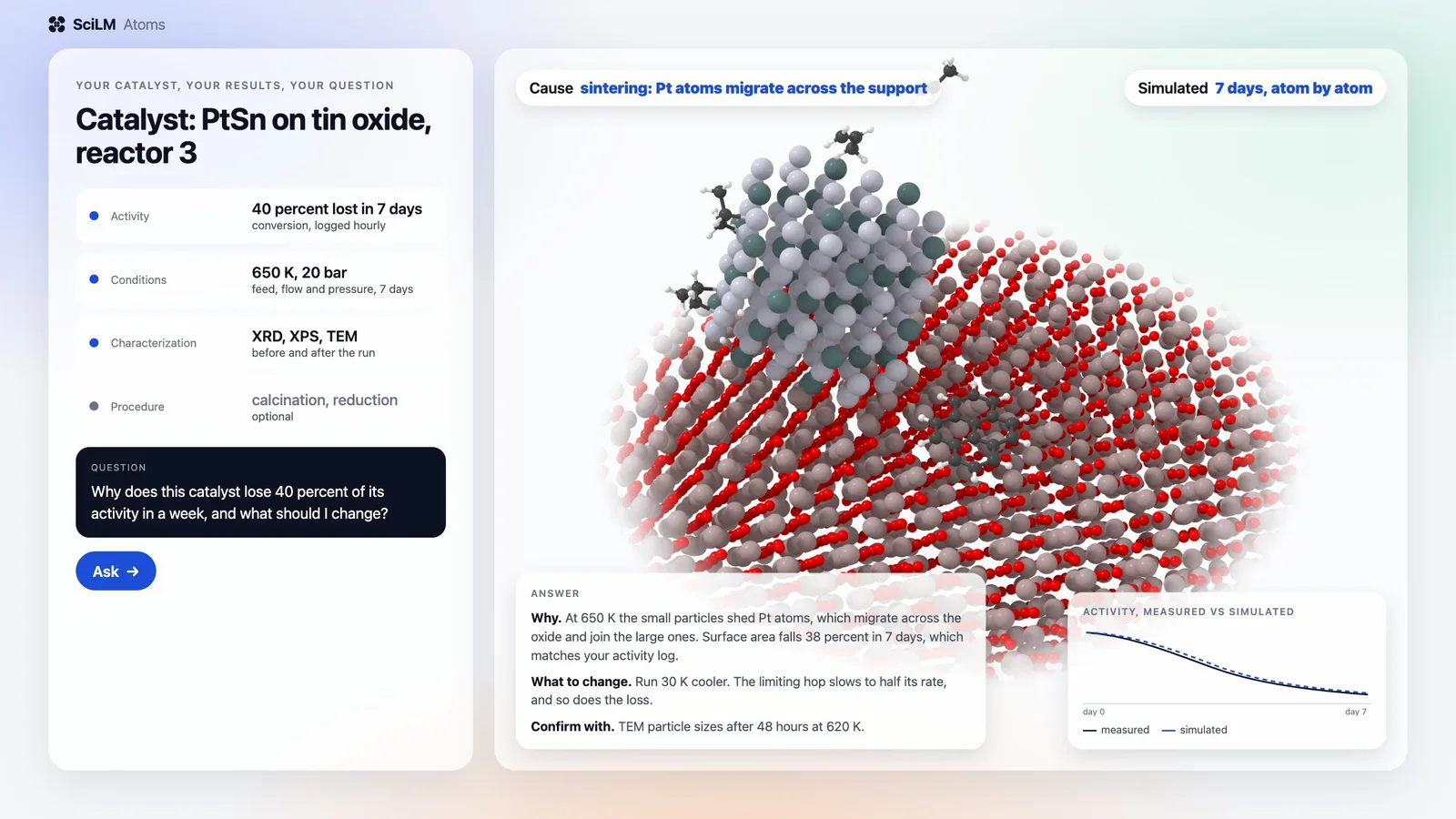
The interface as designed; the model behind it is described below.
What you give it
- Your results: activity and selectivity over time, under the conditions you ran.
- Characterization: XRD, XPS, TEM, chemisorption, before and after, in whatever form you have it.
- The procedure: preparation, pretreatment, operating conditions. Optional.
- The question: why it degrades, what would happen if, what to change. In plain words.
What you get
- The answer: the mechanism, down to which atoms move and which step limits the loss.
- The evidence: the simulations it ran and how they fit your measurements.
- What to change: operating conditions or procedure, with the gain each change buys.
- The next experiment that would confirm it, and weeks of expert and simulation time saved.
How it works.
It works like an expert, with no one in the loop. It reads your results, forms hypotheses about what degrades the catalyst, sintering, poisoning, coking, a surface that rebuilds itself, and tests each by simulation until the simulations explain your data. Then it tells you what to change, and which experiment would confirm it.
Molecular dynamics, sped up with AI. Deactivation is atoms moving: a metal atom leaving a particle, a poison binding a site, a surface rearranging. Standard molecular dynamics follows every atom one tiny time step after another, far too slowly to reach the events that decide a catalyst's life. Our AI-accelerated molecular dynamics is a generative model trained to produce those trajectories directly.
Trained on the rare events. The events that matter most are the rarest: atoms crossing high energy barriers. We launch trajectories from the 33.9 million barrier crossings of MaterialsSaddles, the largest set of its kind, so the model learns how atoms get over them, grounded in physics rather than guessed.
Built around your question. The model answers a physical question; yours is an operating one. With each customer we design the agent that connects the two: it turns your results and your question into simulations, and the simulations into what to change. The same model covers semiconductor surfaces, batteries and solid-state electrolytes; catalysts are where it ships first, and semiconductors come next.