SciLM Subsurface
Give it the field's data. Get every geology that fits.
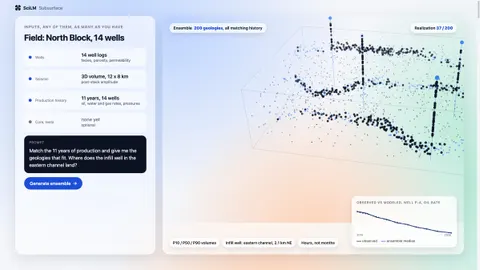
Wells, seismic and the field's production history go in. Every geology consistent with all three comes back, as an ensemble, in hours. History matching is the biggest problem in reservoir simulation; this is the model that solves it.
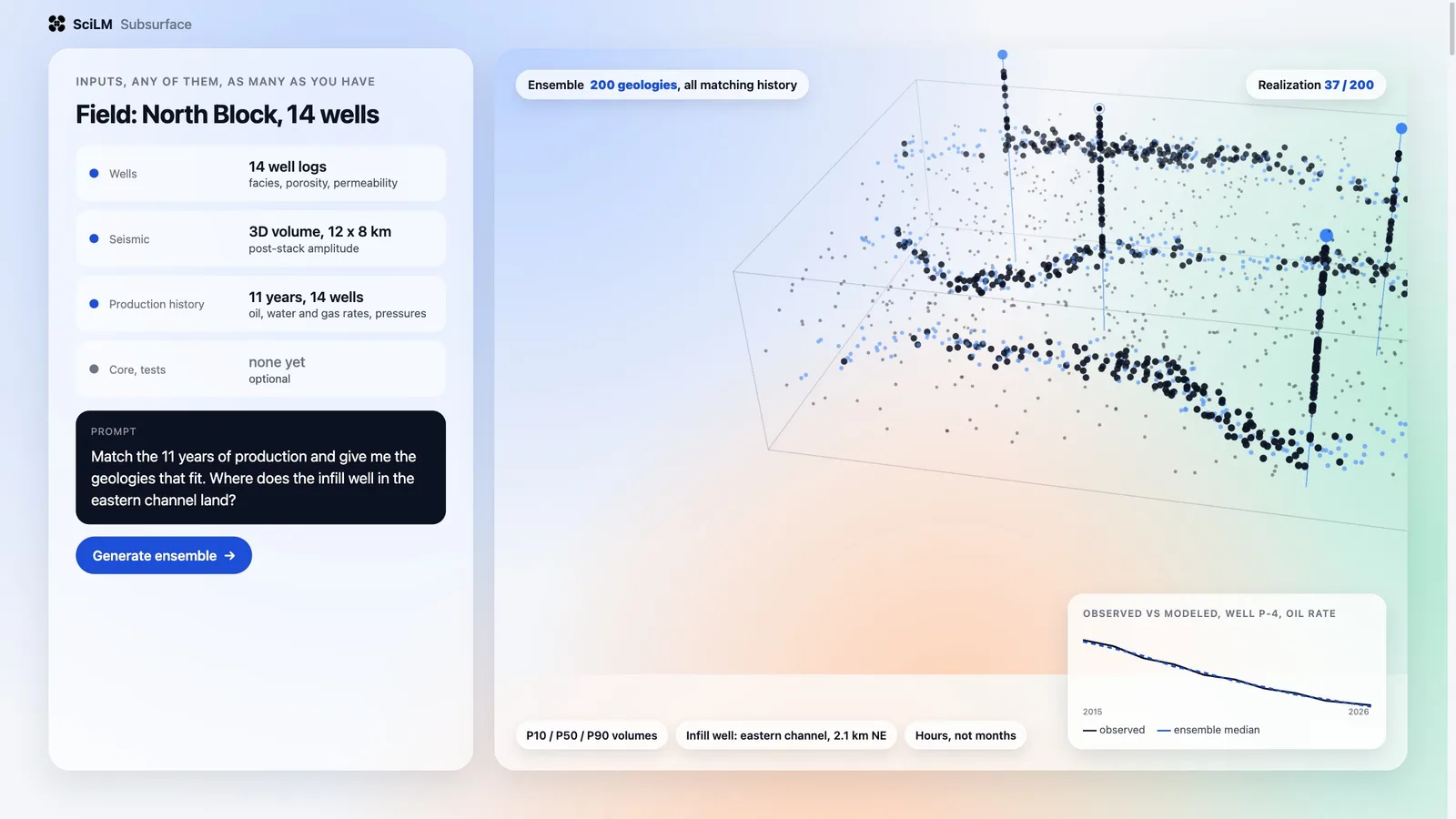
The interface as designed; the model behind it is described below.
What you give it
- Wells: logs, facies, porosity and permeability, any number and orientation.
- Seismic: a post-stack volume, when you have one.
- Production history: oil, water and gas rates and pressures per well, over the life of the field.
- Anything else: core, tests, a prompt for what you expect. Nothing is required.
What you get
- An ensemble of geologies that honor every well and match the production history.
- Facies, porosity and permeability in every voxel, in the format your simulator reads.
- Uncertainty that is real: P10, P50 and P90 volumes from hundreds of realizations, not one hand-tuned model.
- Hours, not months for a history match; the same afternoon for where the next well lands.
How it works.
It learned geology from a million reservoirs. We generated SiliciclasticReservoirs, one million 3D reservoirs across eight depositional architectures, with the rules geologists use, and trained ResFlow on them: one flow-matching model that generates any of those architectures, conditions on any number, location and orientation of wells, and assembles fields of any size.
It reads production history as data, not as text. An LLM can write a script, but it cannot create or edit a geology from a prompt or from a new kind of data. SciLM Subsurface is the only generative model that learns geology directly from observed production history, alongside the wells and the seismic, so the ensemble it returns is the one the field's own behavior selects.
It gives an expert's first guess. A text model starts each round of history matching from whatever a simulator hands it. A model trained on the geology itself starts close to the answer, the way an experienced reservoir engineer does, and reaches it with fewer expensive simulation runs.