SciLM Atomic Kinetics
Give it a material. Get its kinetics back.
How lithium moves through a cathode or a solid-state electrolyte, how a catalyst turns over, how a deposited layer rearranges on a semiconductor surface: every one of these is atoms crossing barriers, at rates no experiment can watch and no molecular dynamics run can reach. SciLM Atomic Kinetics finds the barriers with SaddleFlow and runs the clock with adaptive kinetic Monte Carlo, from microseconds to years. Wherever a saddle search and kinetic Monte Carlo are the tool, it applies.
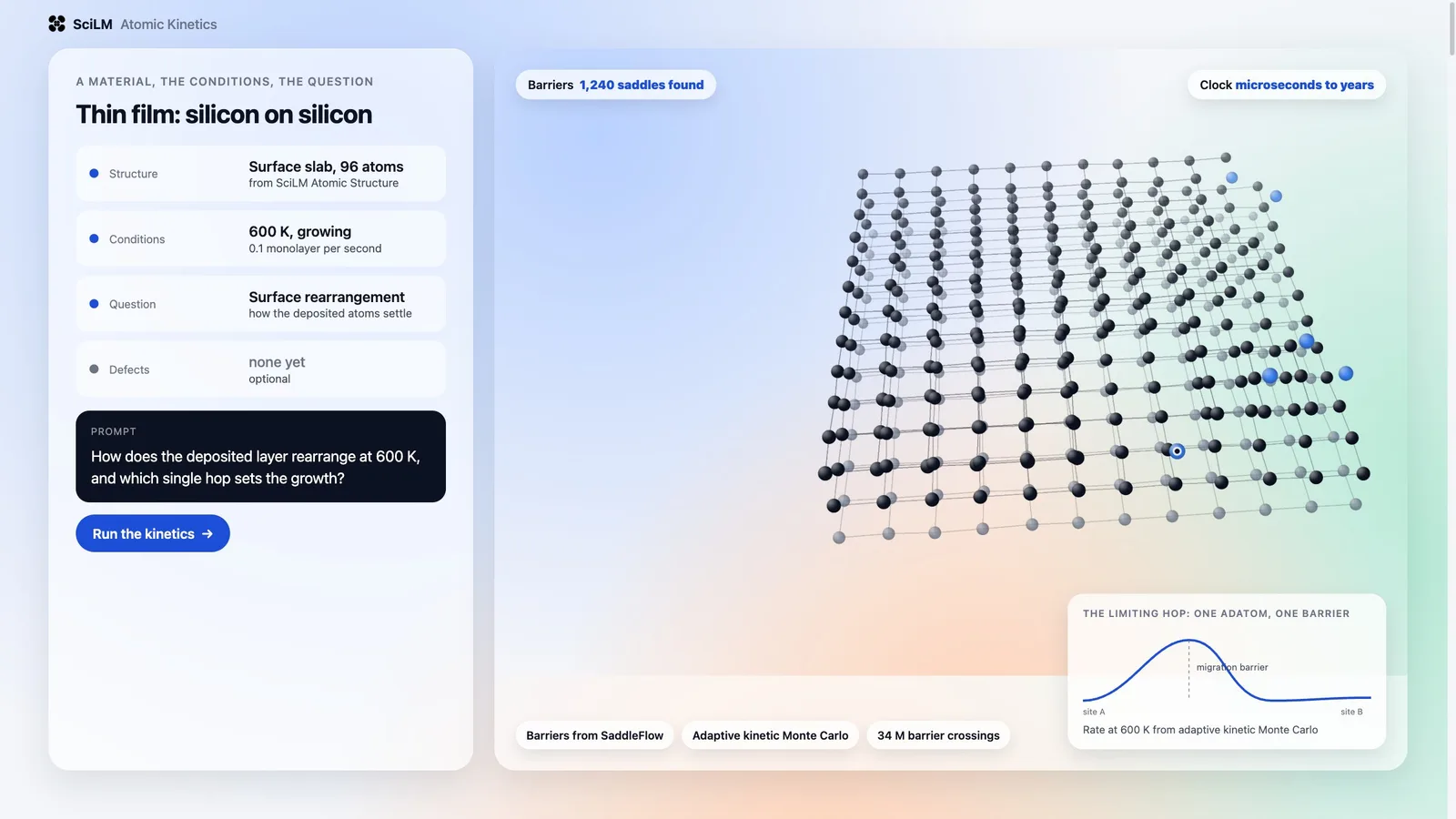
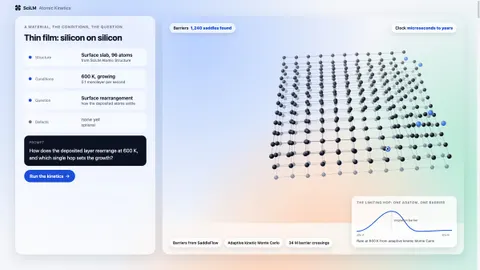
The interface as designed; the model behind it is described below.
What you give it
- A structure: a CIF, or the answer SciLM Atomic Structure just gave you.
- The conditions: temperature, composition, state of charge, coverage.
- The question: ion transport, a reaction network, catalyst turnover, how a surface rearranges, how a defect moves.
- Anything else: known defects, a prompt for what you expect. Nothing is required.
What you get
- The barriers and transition states every atom in the material crosses, found, not searched for.
- Rates and pathways over the real timescale, microseconds to years, from adaptive kinetic Monte Carlo.
- The limiting step: the one hop that sets the charging rate, the turnover, the growth of a film.
- Weeks of simulation saved: the saddle search that dominates a kinetics study is a model call.
How it works.
SaddleFlow proposes the transition states. We generated MaterialsSaddles, 34.14 million barrier crossings across inorganic materials, the largest set of its kind, and trained SaddleFlow on them: the first generative model for transition states in inorganic materials. Where a kinetics study spends its compute searching for saddles one at a time, SaddleFlow proposes them from the structure. Batteries, solid-state electrolytes, catalysts, the reconstruction of a semiconductor surface: the same model covers them all, because all of them are barrier crossings.
Adaptive kinetic Monte Carlo runs the clock. Given the barriers, the method our advisor Graeme Henkelman's group built its EON code around walks the material from state to state at the true rate, reaching timescales molecular dynamics cannot. Our engine is our own implementation of that method, written to our standards around SaddleFlow.
It starts where SciLM Atomic Structure ends. Solve the structure from your experiments, then hand it over: the two products share the data, the model and the question a materials team asks next, which is how the material behaves in time.